


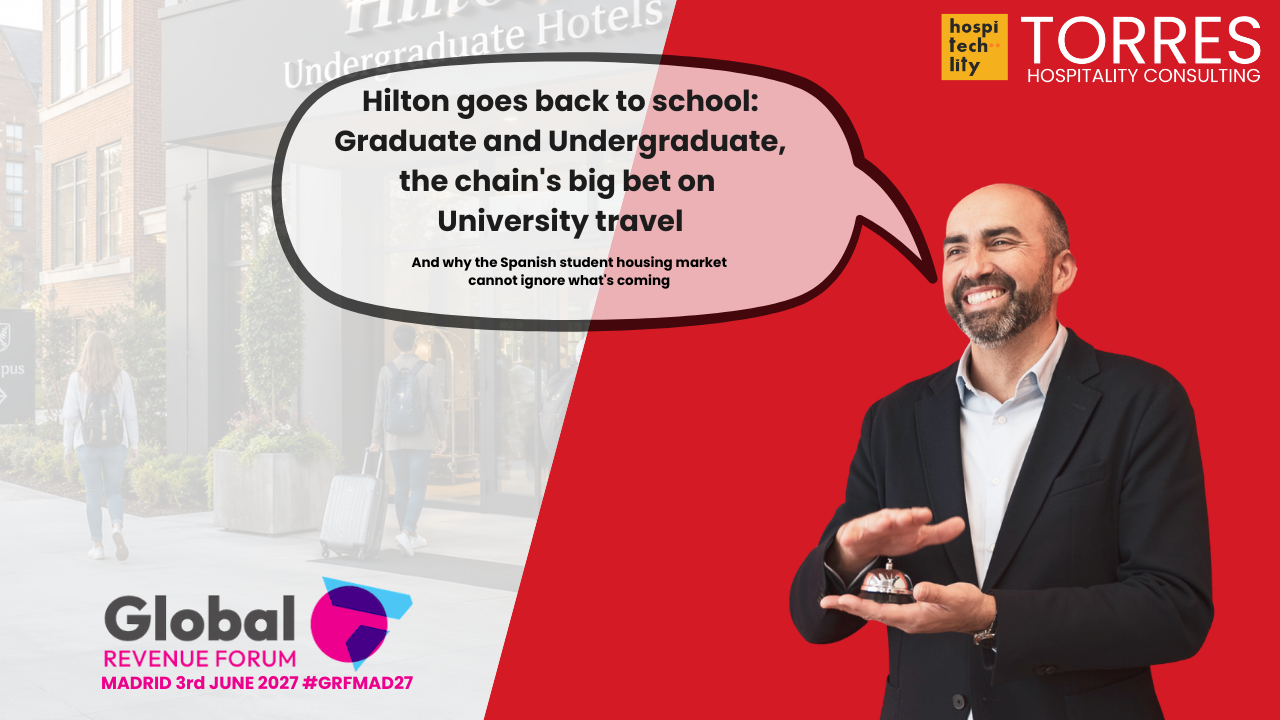
Cuando Hilton pagó 210 millones de dólares en 2024 para adquirir Graduate Hotels, muchos analistas lo archivaron como «apuesta lifestyle». Una más. Pero lo que ha ocurrido desde entonces revela algo más deliberado: Hilton está apostando, con convicción y a escala, por un segmento que la industria hotelera convencional ha infravalorado durante décadas: el viajero universitario y el ecosistema de campus.
El movimiento más reciente —el lanzamiento oficial en junio de 2026 de Undergraduate by Hilton, su marca número 27— es una declaración de intenciones por parte de una de las mayores compañías hoteleras del mundo sobre dónde ve el crecimiento de la próxima década.
Dos marcas, una misma lógica estratégica
La arquitectura de la estrategia es elegante en su simplicidad.
Graduate by Hilton opera en el segmento upper-upscale. Es un concepto con un diseño muy cuidado, construido para contar la historia de mercados universitarios dinámicos a través de capas de significado y un diseño altamente personalizado. Piensa en hoteles con carácter propio, con un precio acorde, anclados en grandes ciudades universitarias. Desde la adquisición, Hilton ha hecho crecer el portfolio de Graduate de 35 hoteles abiertos o en desarrollo a casi 60.
Undergraduate by Hilton es la respuesta a la pregunta obvia que sigue: ¿y qué pasa con cada campus que no puede sostener un Graduate? Es una marca upper-midscale construida para servir a una gama más amplia de mercados universitarios, con un modelo de desarrollo flexible que admite tanto proyectos de nueva construcción como de conversión, permitiendo un desarrollo más eficiente y escalable para los propietarios.
La diferencia de posicionamiento va más allá del precio. Mientras Graduate existe como un concepto totalmente inmersivo y a medida, diseñado para contar en profundidad la historia de cada mercado universitario, Undergraduate está pensado para canalizar ese mismo espíritu a una escala más limitada, en mercados más pequeños.
En cuanto a diseño, las zonas comunes incluirán lounges inspirados en bibliotecas, espacios de encuentro social, un market con barista 24 horas y una carta de cócteles. Las habitaciones están pensadas para evocar «aulas creativas», con rincones de estudio y almacenamiento funcional.
Las cifras detrás de la apuesta
La ambición de Hilton es difícil de subestimar. A largo plazo, Undergraduate by Hilton tiene potencial para expandirse a entre 400 y 500 hoteles, sumados al pipeline ya identificado para la marca Graduate. La compañía planea abrir 700 hoteles lifestyle a nivel global de aquí a 2028.
Se espera que las tarifas objetivo por noche de Undergraduate se sitúen entre 120 y 140 dólares, posicionando la marca en el segmento upper-midscale (dos escalones por debajo de la categoría upper-upscale en la que opera Graduate).
El reto es real, sin embargo. La demanda en las ciudades universitarias tiende a ser irregular, concentrada en torno a eventos clave como fines de semana deportivos, graduaciones y periodos de mudanza, lo que complica la gestión del RevPAR fuera de esos picos. La respuesta de Hilton combina la integración con el programa de fidelización Hilton Honors, la conversión de propiedades existentes y un impulso deliberado para atraer un mix de demanda más amplio —viajeros de negocios, asistentes a congresos, antiguos alumnos y familias— que ayude a suavizar la curva de estacionalidad.
¿Y España? El elefante en la habitación
Hilton no ha anunciado planes concretos para abrir propiedades Graduate o Undergraduate en España. Pero el contexto del mercado español hace que este análisis sea algo más que un ejercicio académico, porque el país presenta uno de los desequilibrios entre oferta y demanda de alojamiento estudiantil más marcados de toda Europa.
Los datos son contundentes:
En 2024, la demanda potencial de plazas de alojamiento estudiantil en España alcanzó las 655.174, mientras que la oferta disponible se limitaba a 108.604 camas operativas, lo que significa que solo uno de cada cinco estudiantes que necesitaban una plaza pudo acceder a ella.
La oferta de residencias de estudiantes en España cubre solo el 7% de la demanda, muy por debajo de la media europea del 20%, y muy por detrás de mercados como el Reino Unido (32%), Francia (17%) y los países nórdicos (en torno al 20-23%).
La presión geográfica es igualmente llamativa: Madrid lidera con 107.335 camas demandadas, seguida de Barcelona con 62.061, Valencia con 41.531, Sevilla con 35.269 y Granada con 28.931.
El capital ya se ha dado cuenta. La inversión en residencias de estudiantes sumó 756 millones de euros hasta diciembre de 2024, multiplicándose por diez respecto al mismo periodo del año anterior. El segmento de residencias de estudiantes moderno lidera el crecimiento, con un incremento del 73% desde 2021, alcanzando ya las 56.062 camas.
Se proyecta que 2025 cierre como el mejor año registrado para la inversión en PBSA (Purpose-Built Student Accommodation, alojamiento estudiantil construido para tal fin) en España, alcanzando los 1.700 millones de euros, un incremento del 151% respecto al año anterior.
Los niveles de ocupación cuentan el resto de la historia. En Valencia y Murcia, la ocupación de las plazas de alojamiento estudiantil disponibles alcanza el 95%, mientras que en Salamanca, Málaga y Sevilla ya ronda el 90%.
¿Y qué tiene que ver Hilton con todo esto?
Directamente, por ahora, muy poco. Pero la lógica de negocio subyacente es idéntica a ambos lados del Atlántico.
Merece la pena precisar qué está construyendo realmente Hilton. Undergraduate by Hilton es una marca hotelera diseñada para mercados universitarios, no un concepto de vivienda estudiantil. Los hoteles recibirán a un abanico de viajeros que incluye estudiantes, residentes locales, padres, antiguos alumnos, aficionados al deporte y huéspedes de negocios o congresos. El campus es el contexto, no el único cliente.
Y esa distinción es precisamente lo que hace esto estratégicamente interesante para el mercado español. España tiene una crisis de alojamiento estudiantil que ninguna cadena hotelera convencional ha abordado con una identidad propia. Las ciudades universitarias medianas (Salamanca, Granada, Valladolid, Pamplona, Santiago de Compostela) generan una demanda intensa, recurrente y multiperfil, con muy poca oferta hotelera de marca que hable su idioma. Ese es exactamente el perfil de mercado para el que se construyó Undergraduate.
La pregunta que deberían hacerse los hoteleros españoles no es si Hilton llegará. Es quién llega primero.
La conclusión para el sector
El movimiento de Hilton es significativo no solo como noticia corporativa, sino como señal de tendencia. El viajero universitario (estudiante, familiar, participante de Erasmus, delegado de congreso, antiguo alumno) ha sido tratado históricamente como un huésped de bajo valor, sensible al precio y sin fidelización. Hilton está demostrando que, cuando se le ofrece un contexto con identidad, intención de diseño y comunidad, ese huésped tiene un potencial de ingresos considerablemente mayor de lo que sugieren las previsiones tradicionales.
Para los hoteles de toda Europa que operan cerca de campus universitarios, el mensaje es claro: el posicionamiento importa, la demanda ya está ahí, y una cadena con 1,3 millones de habitaciones y 250 millones de miembros de fidelización acaba de declarar que este segmento merece la pena disputarse.
Hablemos de cómo tu hotel puede crecer en ingresos sirviendo a los huéspedes que realmente valoran lo que haces. Visitatorreshospitalityconsulting.com o conecta directamente en LinkedIn.