


One theme I'm seeing more and more in performance data across Europe is simple: revenue continues to grow, but profit is becoming increasingly difficult to protect.
A recent benchmarking update published by Hospitality Net (from Duetto/HotStats) shows that the overall GOP margin in Europe is around 37% year-to-date, virtually flat compared to last year, even as revenues rise. In Spain specifically, TRevPAR is up ~3% and GOPPAR ~4% year-to-date, but the GOP margin is essentially unchanged (~41%).
That "flat margin" story is where ancillary revenue stops being a "nice to have" and becomes a profit strategy.
The pressure on the margin is real.
The same report highlights cost pressures that operators feel every day:
Labor costs: up by approximately 5% across Europe, and by approximately 4% in Spain. Non-distributed costs remain high (commissions, supplies). For example, credit card fees and Sales & Marketing expenses are significantly higher than pre-pandemic levels in Spain.
So even when room revenue remains steady, profit doesn't automatically follow. That's why the conversation needs to shift from RevPAR to total revenue plus flow-through.
Ancillary revenue is where hotels regain control
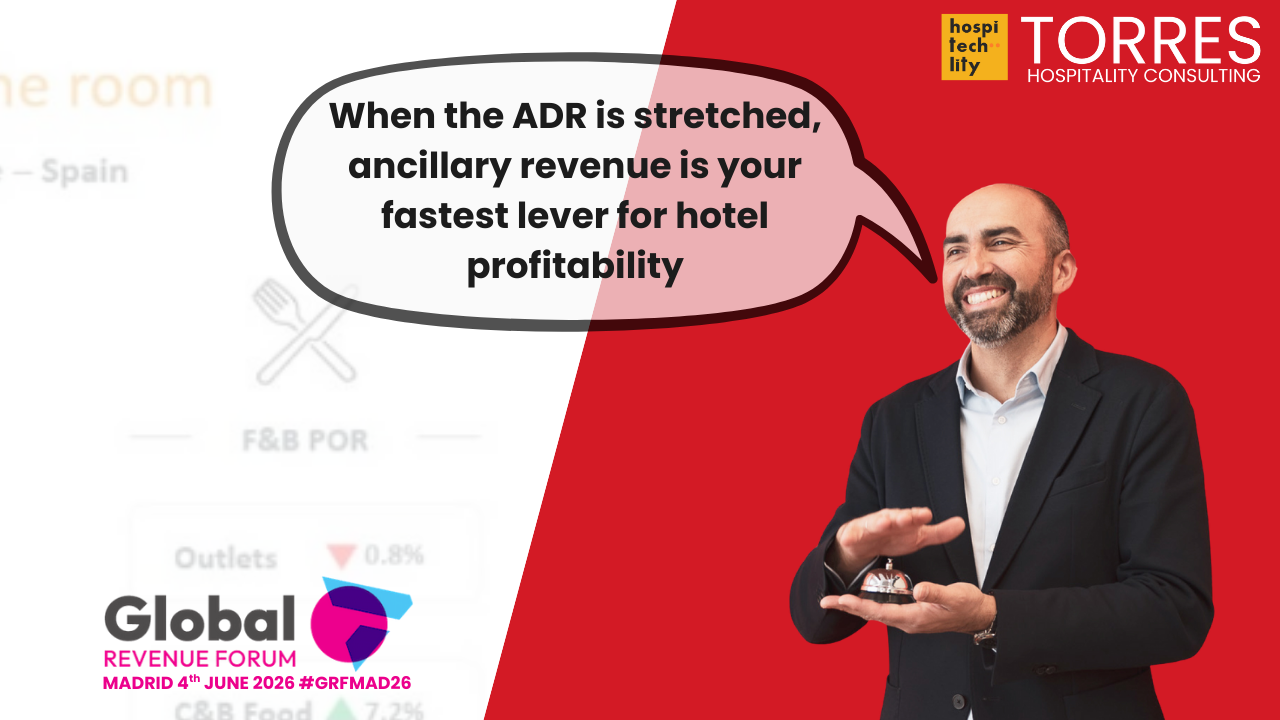
Room rates are (in many markets) near a ceiling: rate resistance, channel costs and demand changes make it difficult to raise ADRs forever.
Ancillary revenue is different because it allows you to: increase spending per guest without relying solely on the rate, distribute demand throughout the property, and build higher-margin revenue streams (if executed with discipline).
HotStats data makes it tangible: "spending beyond the room" is explicitly mentioned: wellness, spa, memberships, health club and conferences & banquets are all part of the profitability equation.
One detail that I found particularly revealing: spa treatment revenue per occupied room (PER) softened slightly (from approximately €8.40 to approximately €8.00), while membership fees and health club revenue grew (from smaller bases). In other words, guests are still spending, but the mix is changing, and hotels that don't measure and adapt will miss out on the potential.
The operational blind spot: "we offer it" is not the same as "we sell it"
Many hotels have ancillaries (spa, parking, late check-out, upgrades, cabins, meeting spaces, experiences)... but they leave the results to chance.
The solution is to design the ancillaries throughout the entire guest journey, not just at check-in.
One framework I like (and that reinforces modern PMS/RMS thinking) is to create upsell moments at five points: booking → pre-arrival → arrival → during stay → post-stay.
If you rely solely on the reception at the time of arrival, you're essentially choosing 1 out of every 5 opportunities.
4 practical moves that increase profitability (not just revenue)
1) Build an easy-to-buy "ancillary menu".
Limit it to 8-12 high-impact items (clarity sells). Write them like products: benefit-oriented, specific, priced, and with scarcity if real (limited availability, peak hours).
2) Price it like a revenue management product, not like a brochure.
Use attribute-based pricing for what guests truly value (views, location, space, quiet floors, early check-in/late check-out). Bundle smartly: upgrades + breakfast, spa + dinner, parking + fast-track check-in.
3) Measure the right KPIs. Examples for SPA:
SRevPOR (Spa Revenue per Occupied Room): Are you monetizing your internal base? RevPATH (Revenue per Available Treatment Hour): Are you using the spa's capacity profitably? ATR (Average Treatment Rate): Are you upgrading or discounting? Therapist Productivity (Utilization + Revenue/Hour): Is scheduling aligned with demand? GOPPATH (Gross Operating Profit per Available Treatment Hour): Are you growing profit, not just the top line?
(If you're not consistently measuring at least 3-4 of these, you're managing by intuition.)
4) Form and incentivize the teams (this is where most programs win or die).
Ancillary revenue is a people game disguised as a pricing game. What works in practice: micro-training (15-20 minutes/week): 1 product, 1 script, 1 objection, 1 upsell opportunity. Recognition loops: daily ranking + weekly mentions. Simple, but it changes behavior quickly.