



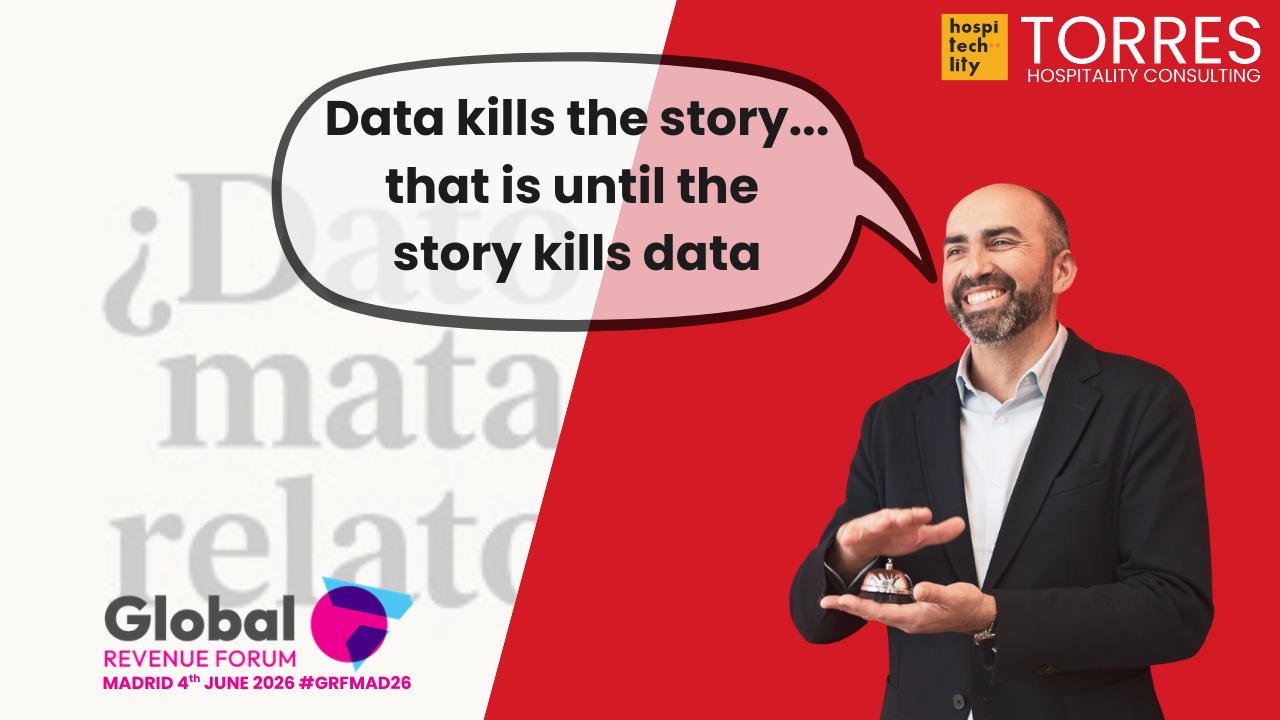
There's a phrase I love because it captures how many of us want the world to work: "Facts kill narratives."
In Revenue Management, that idea is practically a badge of honor. We build our credibility on numbers. We trust pace, pick-up, price elasticity, compset behavior, conversion, and segmentation more than opinions. We like to believe that if the analysis is sound, the decision will follow.
But this is the uncomfortable truth I've seen time and again in hotels: when you can't explain your data well, the story kills the data. And once the story wins in the room, it's very difficult to recover it with another spreadsheet.
This isn't about being "right." It's about being understood. And for a revenue manager, being understood is a business skill, not a soft skill.
Why data loses out in real meetings
Most revenue decisions aren't made on a dashboard. They're made in conversations. They happen in stand-up comedy routines, sales meetings, calls with business owners, and hallway chats five minutes before someone commits to a discount.
And those conversations have their own physics. They move toward simplicity. They reward trust. They favor narratives that feel intuitive, especially under pressure.
That's why you can bring a precise analysis to a meeting and still lose to phrases like:
"We're too expensive." "We need to fill the hotel." "The competition is cheaper." "Let's do the same as last year." "Sales says the market is slow."
Those statements aren't facts. They're stories. And stories are powerful because they reduce complexity to a belief that can be acted upon immediately.
If your data doesn't do the same; if it doesn't translate into a clear belief and a clear action, it will be overtaken by the most compelling narrative in the room.
Revenue management is not just analysis. It's influence.
Many revenue managers are trained to be technically sharp. We learn the logic of forecasting, pricing fences, constraints, displacement, channel costs, and reporting structures. We become excellent at "seeing" the truth in the numbers.
But the job isn't finished when you see it. The job is finished when the organization moves with it.
That requires influence. And influence requires communication.
Because if you don't communicate your recommendation clearly, someone else will fill the silence with a different story. And that alternative story usually comes from:
Operational pain ("we need occupied beds because the restaurant is empty").
Commercial anxiety ("we're under budget, we have to discount").
Fear of competition ("they lowered the rate, so we have to follow them").
The habit ("we always run a promotion in the off-season").
None of this is malicious. It's human. It's what happens when the information is present but not persuasive.
The moment when the story kills the fact
You'll recognize it instantly. It's when the room nods at your chart… and then ignores your conclusion.
You show that pickup is improving, compression is increasing, and the base is stronger than last year. You explain that demand is healthy and that lowering the rate would dilute the ADR without materially improving occupancy. Your logic is correct.
Then someone says, "I understand, but my feeling is that we're not converting."
And suddenly the hotel is discussing feelings, not facts. A discount is approved "just in case." The weekend rate is lowered. The market didn't require it. The hotel fills up anyway. And the result isn't more occupancy. It's lost revenue.
That's the narrative killing the data in real time. Not because the data was wrong. Because the data never landed.
The real problem is the translation, not the truth.
Most of the time, "poor communication" in Revenue Management isn't about being awkward or introverted. It's about failing to translate.
We tend to speak in the language of revenue management. We talk about pace, wash, LOS, displacement, mix, net ADR, contribution, and pickup curves. It's useful internally, but it's not how most stakeholders think.
A CEO typically thinks in terms of trade-offs: "What's the risk, what's the potential, and what do I tell the owner?" Sales thinks in terms of relationships: "Does this price help or hurt my bottom line?" Marketing thinks in terms of messaging: "What do we promote and where do we invest?" Operations thinks in terms of workload: "Will we have the right staff and service level?"
If you present information without connecting it to their mental model, you're asking them to do the translation for you. And when people are busy, they won't. They'll default to the simplest available explanation.
How to make data win again
To make data "kill the story," your communication has to do the same thing a good story does: create clarity, build belief, and drive action.
The change is simple but powerful: stop presenting analyses. Start delivering decisions.
A revenue manager's message becomes stronger when it is structured like this:
You start with the recommendation. You back it up only with the evidence that matters. You name the risk honestly. You end with a clear next step.
This is not oversimplifying. This is professional leadership.
Because in the hotel industry, the best recommendation isn't the most detailed. It's the one that quickly generates alignment.
"Data kills narrative" is still true. But only when the data has a voice. And in Revenue Management, that voice is you.
When you translate data into a clear, credible, and actionable narrative, you make it very difficult for the wrong story to win.
And when you don't, the story will always kill the fact.