

Google has put big numbers behind something many of us in hospitality have felt for years: demand growth does not automatically equal profitability. By 2050, tourism spending could add $4.2 trillion in incremental value and generate 1.9 billion additional trips versus 2025, while the global share of travelers could rise from 50% to 70%. That’s a massive tailwind—on paper.
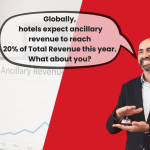
But the real message is more nuanced: demand will also be more fragmented, more expensive to acquire, and operationally noisier. And that’s exactly where my “ancillary revenue eye” kicks in. If distribution complexity and acquisition costs increase, the most defendable lever to protect margins is simple: sell better what you already have inside the hotel: spa, F&B, experiences, upgrades, late check-out, retail, amenities, and beyond.
1) The line that matters most: “ancillaries drive margins” in yield markets
One of the most relevant insights from Google’s broader Travel 2050 work is that Europe and the U.S. are expected to behave as yield-focused markets, where higher spend per trip and ancillaries drive margins. Translation for hotel operators: in mature destinations, you don’t win with occupancy and ADR alone. You win with:
- Higher spend per guest
- Higher service conversion
- A stronger mix
- And less dependence on intermediaries
2) Domestic travel remains the engine: the real gold isn’t always long-haul
Another key point: domestic tourism is projected to remain the backbone of the industry, representing more than 90% of trips. That’s a huge opportunity for ancillaries because domestic travelers tend to:
- Repeat more easily
- Respond well to experience-driven “micro-escapes”
- And, when nurtured properly, deliver the best LTV (Lifetime Value)
Actionable takeaway: Stop treating domestic demand as “shoulder filler.” Treat it as a recurrence platform. Convert a two-night getaway into a guest who comes back for spa, brunch, and curated local experiences.
3) The agentic era is coming: if your ancillary offer isn’t AI-ready, your upsell won’t be either
Google also highlights the move toward agentic AI: not just assisting travelers, but actively managing decisions, including the ability to book within AI-driven experiences. Here’s the ancillary twist: AI agents recommend what they can understand. If your spa menu is a messy list of vague items (“Massage 50 min,” “Deluxe Ritual,” “Relax Package”) with inconsistent attributes, unclear rules, and weak content, it won’t package well, and it won’t sell.
Mantra: automate the logic to scale the magic. The magic is your experience. The logic is your catalog, your data structure, and your sales rules.
The practical playbook for 2026–2027: Ancillary revenue through a Tourism 2050 lens
A) Build “data foundations” for ancillaries
If the future depends on better data foundations, then ancillaries need the same discipline as rooms revenue management. That means:
- Product taxonomy: name, duration, capacity, constraints, price fences, seasonality, recommended guest profile.
- Comparable attributes (crucial for AI and on-site conversion).
- Rules: what bundles with what, sales windows, commissions, and clear policies.
B) Create 3 AI-friendly packages (then measure like a surgeon)
Instead of 20 confusing offers, build three that any agent (or human) can recommend in one breath:
- Quick Win (zero friction): late check-out + 60’ spa access + healthy drink
- Couples: 80’ ritual + dinner + room upgrade
- Family-proof: extended breakfast + local activity + kids amenity
Then track the KPIs that actually tell the truth.
C) Your website is no longer “just branding.” It’s your sales feed for AI
If AI-driven discovery rewards brands with clear, detailed information that answers real questions, your ancillary pages must do exactly that:
- Who is this experience for?
- What benefit will I get specifically?
- How long does it truly take, and what’s included?
This isn’t copywriting for the sake of it. It’s conversion design for humans and machines.
D) Domestic strategy: less discounting, more recurrence
If domestic is the base, the question isn’t, “What promo do we run?” It’s:
- What experience becomes repeatable every 90 days?
- What low-friction membership or pass can we launch?
- How do we turn a stay into a habit?
Simple examples:
- A local Spa Passport (3 visits/90 days + 1 treatment at a preferred rate)
- A Sunday Brunch & Recover concept (low occupancy + idle therapist hours = opportunity)
The human part doesn’t go away. Personalized service remains the true differentiator in a people-to-people industry. AI will amplify reach and efficiency, but your margin will be protected by what algorithms can’t replicate:
- Your ancillaries
- Your team & they take care of guests
- Your culinary experience
Technology will help you sell it better. Ancillary revenue will make it show up in the GOP.
Do reach out: https://torreshospitalityconsulting.com/ Thanks!