



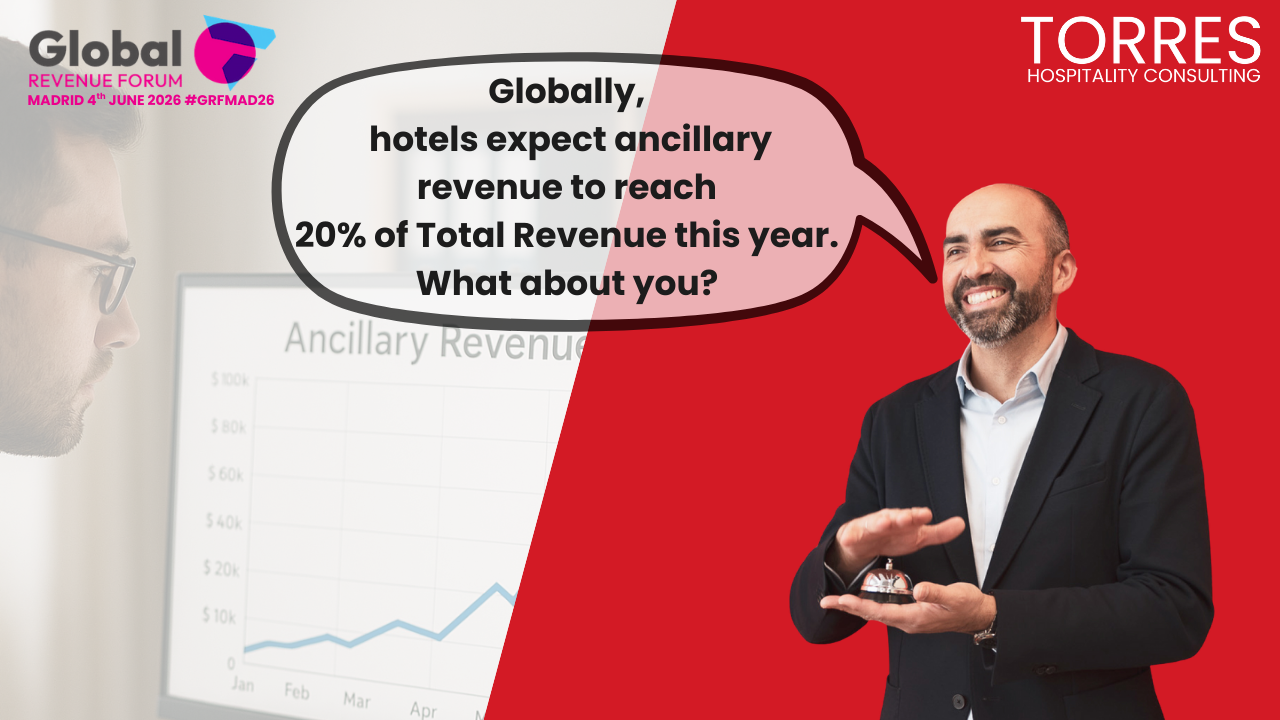
There was a time when ancillary revenue in hotels was a side note: a minibar charge here, a late checkout there. Today, it’s becoming the headline.
According to recent insights from HFTP and Skift, over 85% of hoteliers expect ancillary revenue to represent more than 20% of total income in 2025–2026. That’s not a side dish.It’s becoming the main course.
And who’s plating it all up? Artificial Intelligence.
AI is transforming how hotels package, price, and promote add-ons. Gone are the days of generic upsell banners. Today’s top performers use real-time guest data, predictive algorithms, and context-aware personalization to drive ancillary revenue.
Think less “Do you want to add breakfast?” and more: “We noticed you arrived late and have a table available for brunch at 12:00 noon. Would you want to energize your day for just 30€”
Because personalization is no longer a luxury. It’s the new efficiency.
Not replacing people: Amplifying them
The most successful AI strategies in hospitality don’t replace your staff. They amplify their value. By automating repetitive upsell prompts, adjusting offer timing, and fine-tuning prices by demand, AI frees up human teams to do what they do best: connect, inspire, and convert with empathy.
Response times in AI-augmented operations drop by up to 25%, which is crucial when every second matters in a guest’s decision-making window.
Picture this: a digital assistant embedded in your PMS or guest messaging platform. It behaves like an intuitive friend: anticipating preferences, suggesting upgrades, and nudging guests toward higher satisfaction (and spend). It’s not intrusive. It’s insightful.
Let’s borrow an analogy from fine dining. Imagine you’re at a restaurant and the sommelier recommends a wine. Not just any wine, but the wine that pairs perfectly with your meal and mood.
That’s what AI can be for your hotel operations.
A “digital sommelier” embedded in your booking engine, your app, or your guest messaging tool, constantly learning from past interactions, purchase behavior, seasonal patterns, and even real-time occupancy.
A guest books a standard room? The AI might offer:
- Breakfast in bed with a panoramic view for €25
- Access to a rooftop yoga session for €30
- A late checkout, just before that evening flight, for €60
What feels like a simple suggestion is actually a micro-conversion powered by behavioral insight. Multiply that across hundreds of rooms and channels, and you’re looking at serious incremental revenue.
Also, AI doesn’t just help you sell more. It helps you measure smarter. Leading platforms now track:
- Ancillary revenue per guest per segment
- AI-attributed conversion rates
- Time-to-response for upsell engagement
- Total ancillary as a % of gross room revenue
According to CBRE, smart upselling systems are already driving ancillary revenue to 18% of hotel income on average. And that number is expected to grow as adoption increases in mid-scale and boutique segments, not just luxury.
So how do you begin building this kind of system in your hotel?
- Integrate AI into your existing tech stack Ensure your PMS, CRM, and booking engines talk to each other. AI needs data to be intelligent and context to be relevant.
- Start with high-impact touchpoints Focus on pre-arrival, in-app check-in, and mid-stay nudges. These moments offer the best emotional and transactional windows.
- Test bundles and behavioral triggers Use A/B testing to refine offers: “Upgrade with spa access” vs. “Recharge after your flight—30% off spa.” The message matters.
- Train your team to follow up AI gets you 80% there. A well-timed follow-up from the front desk or concierge seals the deal with authenticity. Investing in training your team is a no-brainer.
AI in hospitality is not just a tech trend. It’s a strategic evolution. It moves revenue from reactive to proactive, from optional to operational. It anticipates needs before guests articulate them. It transforms “maybe later” into “yes, right now.”
And that’s where the future of ancillary revenue is heading: from static pricing to dynamic desire, from transactional to transformational.
The hotels that thrive in 2026 will be those that don’t just sell extras. Instead, will be the ones that curate personalized micro-experiences at scale. And AI is the concierge who never sleeps, always listens, and just might know your guest better than they know themselves.
If you’re thinking, «We should be doing this at our hotel,» you’re not alone. I help hospitality brands like yours move from ideas to implementation. Want to explore how to boost your ancillary revenue with tailored strategies?
Do reach out: https://torreshospitalityconsulting.com/ Thanks!