



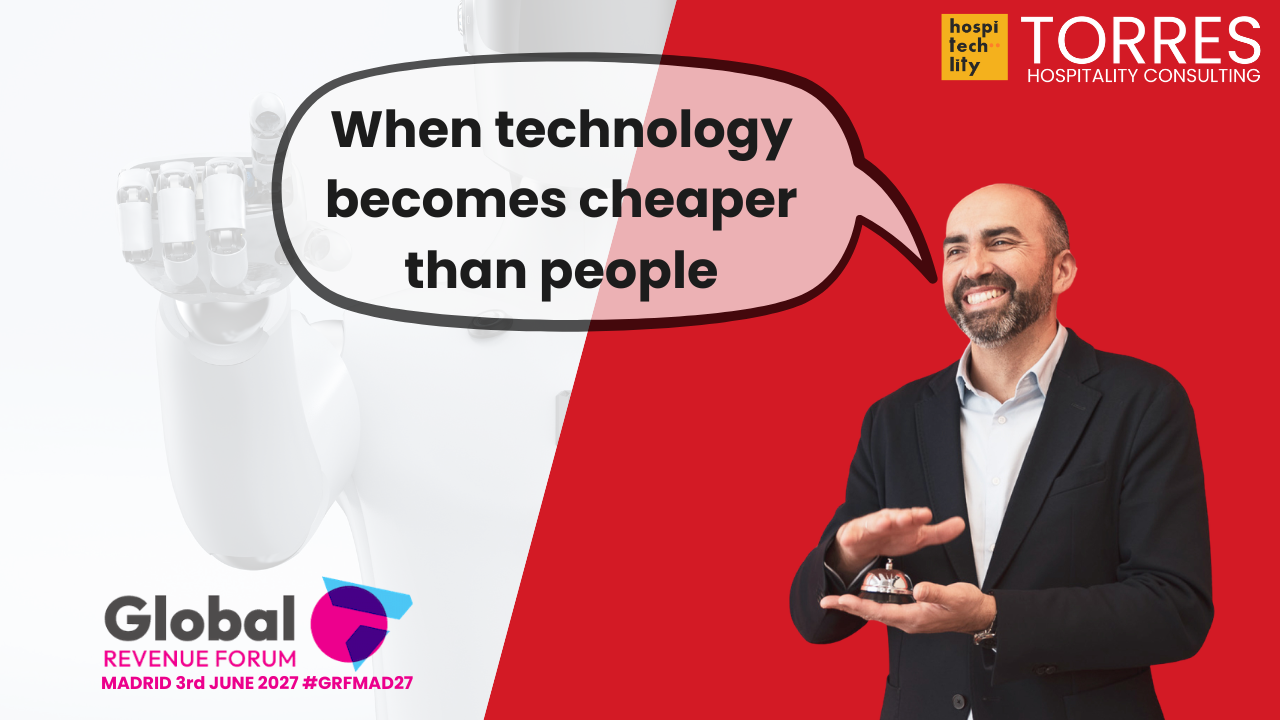
A few years ago, I remember seeing people cutting grass by hand in Pune, India. Not with a lawnmower. By hand. At first, I was surprised. Then someone explained it to me very simply: people were cheaper than machines.
That phrase stuck with me. Because it says a lot about how work changes.
Technology doesn't replace people just when it's better. It replaces them when it's good enough, reliable enough, and cheaper than the alternative.
That's why the conversation about robots in hotel housekeeping is so important.
A recent video about cleaning robots in hotels suggested that, by 2028, robots could begin replacing some of the housekeeping staff in hotels. Whether or not the year is accurate, the trend is clear: robotics is advancing rapidly, and housekeeping is one of the areas where the business case is obvious.
Hotelschool The Hague recently published an analysis explaining that humanoid robots are already being tested in factories, warehouses, domestic environments and, potentially, in hospitality, especially as hotels continue to face labor shortages and high turnover in physically demanding roles such as housekeeping and kitchen.
And we're not just talking about science fiction. Hotel Dive recently reported on how an autonomous robot at a Homewood Suites in California is already helping housekeeping teams move linens and waste, reducing heavy physical labor and improving operational efficiency.
This is the first stage.
Robots don't need to clean the entire room perfectly from day one. They just need to start eliminating the most repetitive, tedious, and predictable tasks.
Move bedding. Transport waste. Vacuum hallways. Clean large common areas. Deliver amenities. Assist with bathroom routines. Replenish essentials.
Once that works, the economic logic begins to change.
The machine doesn't need to be perfect
This is the part that many people underestimate.
A robot doesn't need to be better than the best housekeeper. It just needs to be good enough at certain tasks, be available every day, and be financially attractive.
He doesn't get tired. He doesn't take sick leave. He doesn't go to another hotel. He can work nights. He can repeat the same task without complaining.
Of course, robots still have limitations. They struggle with complexity, improvisation, unusual situations, emotional judgment, and final quality control. Revfine, for example, points out that housekeeping robots today are best used to assist rather than completely replace housekeeping teams, freeing people up to focus on tasks that require human intelligence, creativity, and judgment.
But that's precisely the key. The future won't begin with a complete replacement. It will begin with a partial replacement. And a partial replacement is already enough to change the workforce models.
Humans must move up the value chain
This is where hospitality has a very important decision to make.
If a person only does what a machine can do, that person will end up losing.
Perhaps not today. Perhaps not in all markets. Perhaps not in all hotel categories. But over time, as technology becomes cheaper, the pressure will increase.
The same logic applies as with turf in India. When labor is cheaper than technology, people stay.
When technology becomes cheaper than labor, the individual must justify the difference.
So the question is not: "Are robots going to replace housekeeping?"
The best question is:
"What can a human chambermaid do that a robot can't?"
In luxury hospitality, that's where the difference will be made. A robot can clean a surface. A person can notice that the guest always leaves a book by the bed and place a bookmark next to it.
A robot can deliver towels. A person can see that a family needs extra towels before they ask for them.
A robot can replenish amenities. A person can understand that a returning guest prefers a specific item and make the room feel special.
A robot can follow a checklist. A person can create care.
Luxury will not be less human.
Some people think that luxury hotels should avoid automation to protect human interaction.
I disagree.
Luxury hotels should automate the invisible friction and protect the visible emotion.
Let robots move heavy bedding. Let technology optimize task allocation. Let machines clean large, repetitive areas. Let systems predict workload.
But let's not lose the people who create recognition, warmth, anticipation, and trust.
In luxury, the future human role is not "doing more tasks".
It's about doing more meaningful tasks.
The best hotels will not be those without robots.
Those who use robots intelligently will be the ones who allow their people to dedicate more time to what truly creates value for the guest.
That's the real opportunity.
Not technology instead of hospitality.
Technology at the service of better hospitality.
The revenue angle
This isn't just an HR conversation. It's a revenue conversation.
If robots reduce the cost of repetitive labor, improve consistency, and increase productivity, they affect profitability.
If people use the time saved to improve guest satisfaction, personalize stays, identify service opportunities, and create memorable moments, it impacts loyalty, reviews, repeat business, and willingness to pay.
That's where the business case becomes powerful.
Machines can protect efficiency.
People must protect value.
And in luxury hospitality, value is what protects the price.
At Torres Hospitality Consulting, we help hotels connect technology, operations, guest experience, and revenue into practical strategies that make business sense.
Because the future is not about choosing between people and machines.
It consists of making sure that people do what machines cannot.
TORRES HOSPITALITY CONSULTING