


Hotels don't install check-in kiosks because they hate people.
They install them because many check-in tasks are repetitive, predictable, and easy to automate: confirming identity, collecting payment, assigning rooms, handing over the key, printing information, and processing checkout.
A kiosk can do that quickly, without getting tired, without needing a break, and without making guests wait unnecessarily. McKinsey has highlighted examples of hotels using self-check-in kiosks that allow guests to check in or check out in less than 30 seconds.
So the question is not whether kiosks will become more common.
They will.
The real question is: what should a person do at check-in that a kiosk can't do?
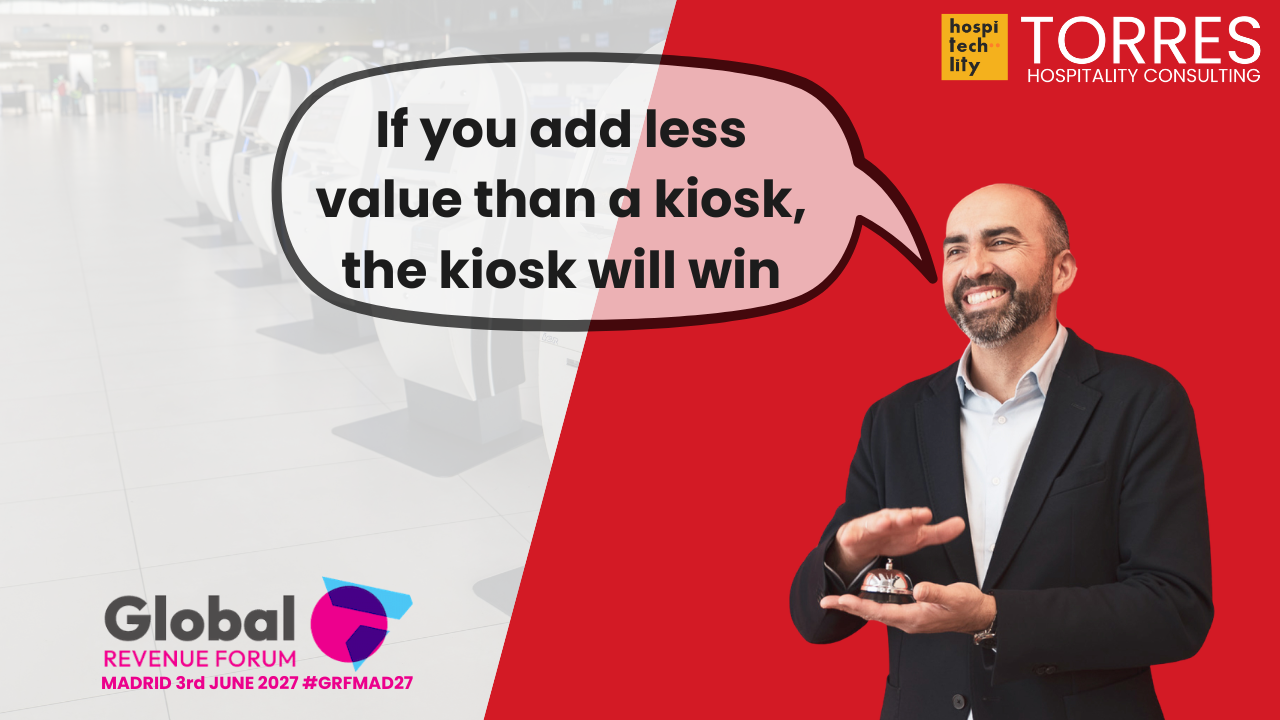
A person cannot simply be a slower kiosk
If the receptionist only asks for the passport, confirms the reservation, hands over the key and says "breakfast is from 7 to 10," we have a problem.
That's not hospitality. That's management.
And administration is exactly what technology knows how to replace well.
The receptionist needs to stop competing with the kiosk on speed and start competing on value. The kiosk should handle the transaction. The receptionist should handle the relationship.
That means reading the guest, understanding the context, detecting opportunities, resolving frictions, and making the arrival feel better than a screen could.
From check-in to the commercial moment
Arrival is one of the most important entry moments of the guest journey.
The guest is physically present. They are attentive. They are thinking about their stay. They are open to information if it is relevant.
This is where a good reception team can generate revenue without sounding like a salesperson.
A kiosk can offer a room upgrade.
A trained person can explain why that upgrade makes sense for that particular guest.
A kiosk can display spa availability.
A person might say, "Stay two nights, and tomorrow the spa will be quieter. If you really want a break, that would be the best time."
A kiosk can display the restaurant's options.
A person might say, "The terrace is beautiful tonight, and if you like local fish, I would book as soon as possible."
That's the difference.
Do not push.
Guide.
The receptionist as a revenue connector
The reception role shouldn't be seen solely as an operational one. It should be a revenue connector.
A good receptionist can identify tired guests and minimize friction. They can spot a couple celebrating a special occasion and suggest the right experience. They can recognize a family needing comfort and recommend practical extras. They can identify a business traveler who values speed, quiet, and flexibility.
This requires training, not scripts.
Scripts make people sound robotic. And if we make people sound robotic, we shouldn't be surprised when robots replace them.
The goal is to give the team the confidence to have better conversations.
What brings you here? Is this your first time visiting? Do you already have dinner plans? Would you like us to help you make the most of your stay? Are you looking for more relaxation, discovery, or comfort?
These questions create context. Context creates relevance. Relevance creates conversion.
What people should do better
To remain valuable, the human experience of check-in needs to focus on five things.
First, emotional intelligence. A kiosk can't accurately read frustration, tiredness, confusion, excitement, or doubt. A person can.
Second, problem prevention. A good receptionist can anticipate issues before they become complaints: room location, schedules, transportation, restaurant availability, special requests.
Third, personalization. Not the fake personalization of "dear guest," but useful personalization based on the reason for the stay.
Fourth, revenue awareness. Every team member should understand the commercial value of upgrades, F&B, the spa, parking, late checkout, experiences, and direct booking education.
Fifth, brand memory. The guest may not remember the PMS, the key encoder, or the check-in form. But they may remember the person who made their arrival easy, warm, and helpful.
Technology should get rid of the boring part
The best use of technology isn't to eliminate hospitality. It's to remove boring, low-value tasks so people can focus on what truly matters.
Have the kiosk scan the passport.
The guest pays digitally.
Let the system hand over the key.
And that the person creates the moment.
Because if technology makes the process faster and the person makes the experience better, everyone wins.
The guest wins.
The team wins.
The hotel wins.
But if the person simply replicates what the kiosk already does, the business case becomes very clear. The kiosk will be cheaper, faster, and more reliable.
That's uncomfortable, but it's true.
The true future of reception
The future of reception is not "people or kiosks".
These are routine tasks for technology, but moments of value for people.
Hotels that understand this will not only reduce queues. They will improve conversion rates, increase ancillary revenue, boost guest satisfaction, and make their teams more relevant.
At Torres Hospitality Consulting, we help hotels connect operations, guest experience, technology, and revenue in practical strategies that make business sense.
Because the goal is not to replace people with machines.
The goal is to make people too valuable to replace.
TORRES HOSPITALITY CONSULTING