
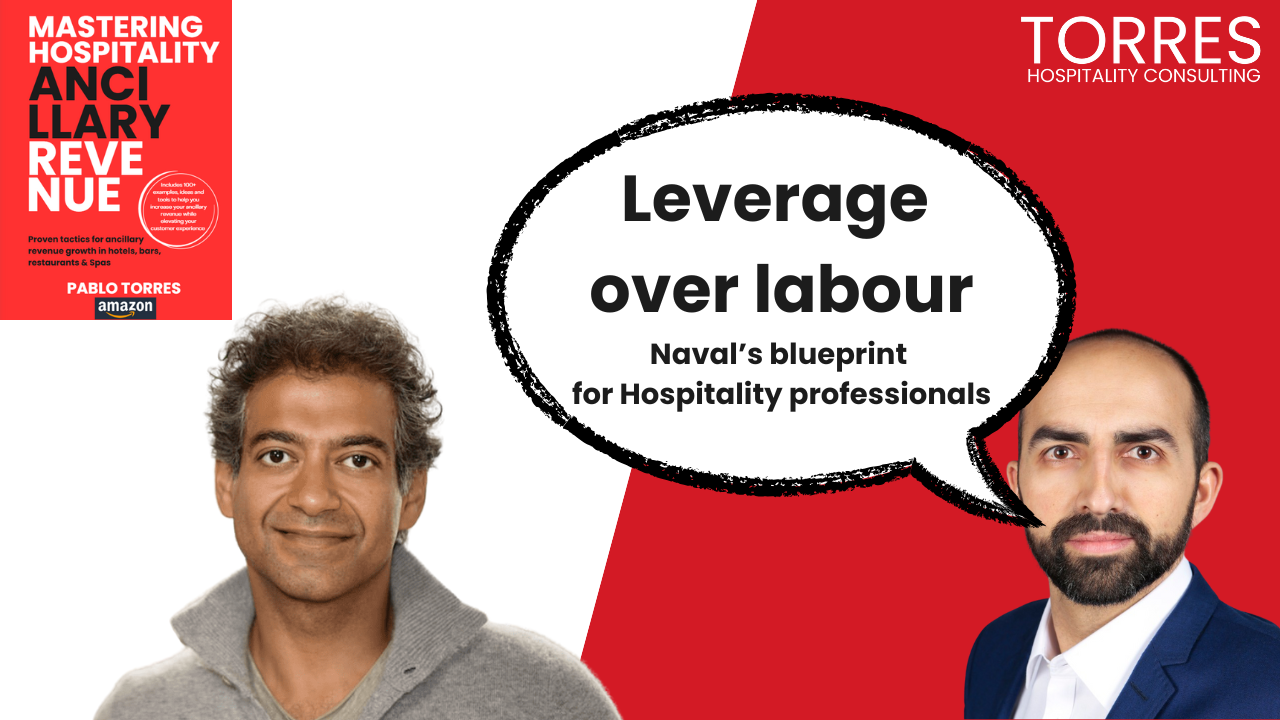
Naval Ravikant isn't a hotelier. He's not in F&B, spa operations, or tech distribution.
But his clarity of thought on wealth, time, leverage, and decision-making might be the most powerful guide for hospitality professionals who want to go beyond titles and build something lasting.
In this week's edition, I explore how Naval's philosophy can elevate how we operate, lead, and grow.From GMs and F &B directors to consultants and entrepreneurs.
“Learn to sell. Learn to build.”
Naval famously says: “If you can do both, you will be unstoppable.”
In hospitality, we often get siloed. You're either great with numbers (revenue manager) or great with people (front office). But if you want to future-proof your career (or scale your influence) you need both:
- Build: Learn to design operational systems, tech stacks, SOPs, and KPI dashboards that run without you.
- Sell: Learn how to communicate your value; internally to owners, externally to LinkedIn, and always to your team.
A marketing director who understands CAC vs. LTV and can you present it in a boardroom? Unstoppable.
Play long-term games with long-term people
Hospitality is notorious for churn: staff turnover, quick wins, short-sighted promotions. But Naval reminds us that long-term thinking multiples results.
In practice, that means:
- Building partnerships with vendors, not just price-based suppliers.
- Developing team members who can outgrow roles, not just fill them.
- Sharing consistently online to compound your personal brand, not chasing viral moments.
This is the difference between a revenue leader who hops roles every 18 months… and one who becomes a trusted name in hospitality strategy.
Leverage = Growth without more hours
Naval breaks down leverage into four types: Labour, capital, average, and code.
Most hospitality leaders only use one: Labour. We hire more people. Train more people. Manage more people.
But if you want scalable impact:
- Use media: Write posts. Share frameworks. Publish insights on RevPATH, TRevPSqm, or average ticket. It builds reach… even while you sleep.
- Use code: Automate reports. Integrate AI tools into guest messaging orF&B reservations.
- Use capital: Invest in systems that reduce manual intervention: from CRM to optimization tools.
Stop trading time for impact. Start using leverage.
“Retirement is when you stop sacrificing today for an imaginary tomorrow”
Hospitality often rewards hustle: long nights, 6-day weeks, answering emails on vacation. But Naval challenges this culture of martyrdom.
The goal isn't to retire at 65. It's to build a life you don't need to escape from.
That means:
- Delegating smarter, not doing more.
- Defining what success looks like for you (Maybe it's not being a GM. Maybe it's owning your boutique consultancy).
- Learning how to detach from urgency and lead with judgment (shout-out to Jocko, check last week's article).
Freedom in hospitality isn't quitting the industry. It's learning to lead on your terms.
Specific knowledge: What do you know that others don't?
Naval defines specific knowledge as the thing you can't teach easily, the stuff that feels like playing to you, but looks like work to others.
For hospitality pros, that could be:
- Intuitively understanding guest behavior and upsell moments.
- Seeing patterns in bar revenue that others miss.
- Turning boring data into memorable visuals that change decisions.
Double down on it. Make it your signature. Then share it: in meetings, in mentoring, in your online content. That's how you go from operator… to irreplaceable.
Escape competition through authenticity
Naval says: “The way to truly escape competition is to be authentically you; because no one can compete with that.”
In hospitality, where many look and sound the same, Your edge is your clarity:
- What do you stand for?
- What problem are you solving?
- What kind of leader do you want to be known as?
You don't need more credentials. You need more signal. And Naval's mindset gives you the blueprint.